

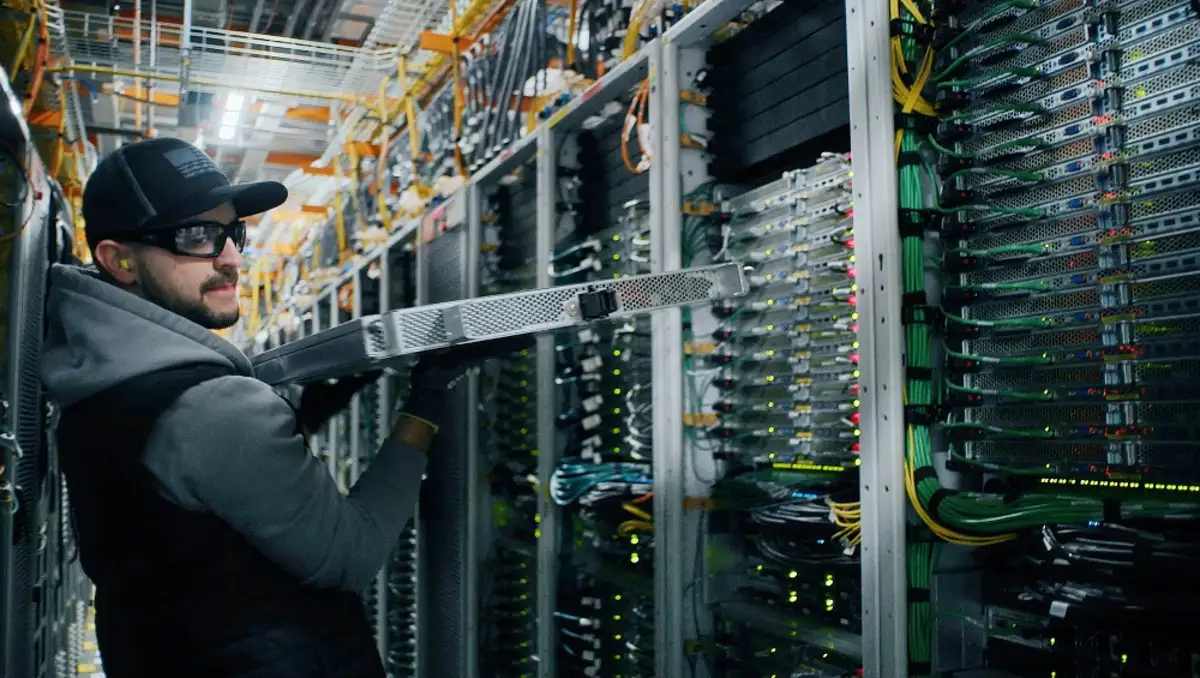
If you think your electricity bill is rising, you should see what’s happening in Northern Virginia. Or Dublin. Or any of the world’s “data center alleys.”
We’ve officially entered the AI Energy Crunch.
For years, the tech world lived in a cozy reality where software efficiency mostly kept pace with hardware growth. But then came the Large Language Models (LLMs). Training a single massive AI model can now consume as much power as 1,000 households do in a year. And in 2026, we aren’t just training models; we are running billions of inferences every single hour.
This insatiable appetite for power has sent the world’s “hyperscalers”—Google, Amazon, Microsoft, and Meta—into a localized arms race. They aren’t just fighting for GPUs; they are fighting for every available megawatt of clean energy. And their primary weapon of choice? RECs.
The “Giga-Problem”: Why AI Can’t Just Use “Normal” Electricity
To understand why RECs are suddenly more valuable than Bitcoin in some circles, you have to understand the math of a modern AI campus. We are no longer talking about “megawatts.” We are moving into the era of the Gigawatt Data Center.
According to the International Energy Agency (IEA), global data center electricity consumption is projected to top 1,000 TWh by the end of 2026. To put that in perspective, that’s roughly the entire electricity demand of Japan. AI alone is the “super-driver” of this growth, with generative AI training clusters consuming 7 to 8 times more energy than a typical cloud workload.
But here’s the catch: these tech giants have all made public, legally binding “Net Zero” or “100% Renewable” promises. They can’t just plug into a coal-heavy grid and call it a day. Their investors, customers, and regulators won’t allow it. They need a way to prove that for every MWh their GPUs burn, a MWh of wind or solar was fed into the grid. This is where the Renewable Energy Certificate becomes the most important piece of paper in Silicon Valley.
RECs: The Secret Currency of the Hyperscalers
In the energy world, RECs (Renewable Energy Certificates) are the accounting mechanism that tracks who gets to claim “green” power. When a wind farm in Iowa generates electricity, it produces two things: the physical electrons (which go into the generic grid) and the “renewable attribute” (the REC).
By buying up RECs at record rates, AI companies are effectively “claiming” the clean energy produced by distant projects to offset the massive loads they are placing on local grids. In 2026, the demand for Green-e certified certificates has hit an all-time high. Why? Because it’s the fastest way to bridge the gap between their soaring power needs and the slow-moving reality of grid infrastructure.
It’s a classic supply-and-demand squeeze. The AI boom has created a surge in power demand that is outpacing the construction of new transmission lines. Since building a new high-voltage line can take 10 years, but buying a REC takes 10 seconds, the “market-based” reporting method has become the lifeblood of corporate sustainability teams.
The Supply Squeeze: What This Means for Everyone Else
If you’re a mid-sized business or a smaller enterprise, you might want to pay attention. The “Big Four” tech companies are now the largest buyers of renewable energy on the planet. By locking in massive, multi-year contracts for RECs, they are effectively “front-running” the market.
This has led to a phenomenon I call “REC Inflation.” As data centers in places like Ireland (where they may soon consume 32% of national power) and Virginia (where they consume over 25%) scramble for credits, the price for high-quality, local certificates is trending upward. We are seeing a “flight to quality.” Companies no longer want cheap, unbundled credits from five states away; they want “Impact RECs” from the same grid where their servers live.
If you’re a smaller company trying to hit a 2030 sustainability goal, you aren’t just competing with your industry rivals; you’re competing with an AI that never sleeps and has a multi-billion dollar procurement budget.
From Annual Averages to 24/7 Matching: The 2026 Pivot
The most sophisticated players have realized that simple annual matching isn’t enough anymore. In 2026, the conversation has moved toward 24/7 Carbon-Free Energy (CFE).
The old way was easy: Use 1,000 MWh of “dirty” power during the year, buy 1,000 RECs at the end of the year, and call yourself “100% Green.” But the atmosphere knows that you used coal at 2 AM when the sun wasn’t shining. To combat this “accounting trick,” leaders like Google are pioneering Hourly Matching.
They are using AI itself to shift data center workloads to different parts of the world based on when renewable energy is most abundant. They are looking for RECs that are timestamped. This “Granular Certificate” movement is the next frontier. It’s no longer about how many credits you have; it’s about when those credits were generated and if they actually match your real-time consumption.
The Competitive Moat: Energy as a Strategic Constraint
In 2026, the ability to secure power is the ultimate competitive advantage. Nvidia’s CEO Jensen Huang recently noted that computing demand is growing exponentially, but the grid is not. This has transformed energy from an operational expense into a strategic constraint.
Companies that have already secured their RECs and Power Purchase Agreements (PPAs) have built a moat. They can continue to scale their AI models while their competitors are stuck in “interconnection queues,” waiting for the grid to catch up.
If you aren’t thinking about your energy procurement like a hedge fund manager, you’re already behind. The AI Energy Crunch isn’t just a technical challenge—it’s a resource war. And in this war, the ones with the most certificates win.
The Bottom Line
The surge in AI hasn’t just changed how we write emails or write code; it has fundamentally rewritten the rules of the global energy market. Data centers are no longer just “buildings with servers”; they are the most aggressive energy players on Earth.
By gobbling up RECs, these companies are simultaneously funding the energy transition and creating a massive supply squeeze for the rest of the business world. Whether you’re a tech giant or a local startup, understanding how to navigate this high-stakes market is no longer optional. It’s the only way to stay powered—and relevant—in a carbon-constrained world.
